


The True Cost of Paper Checks in Workers’ Comp And Auto
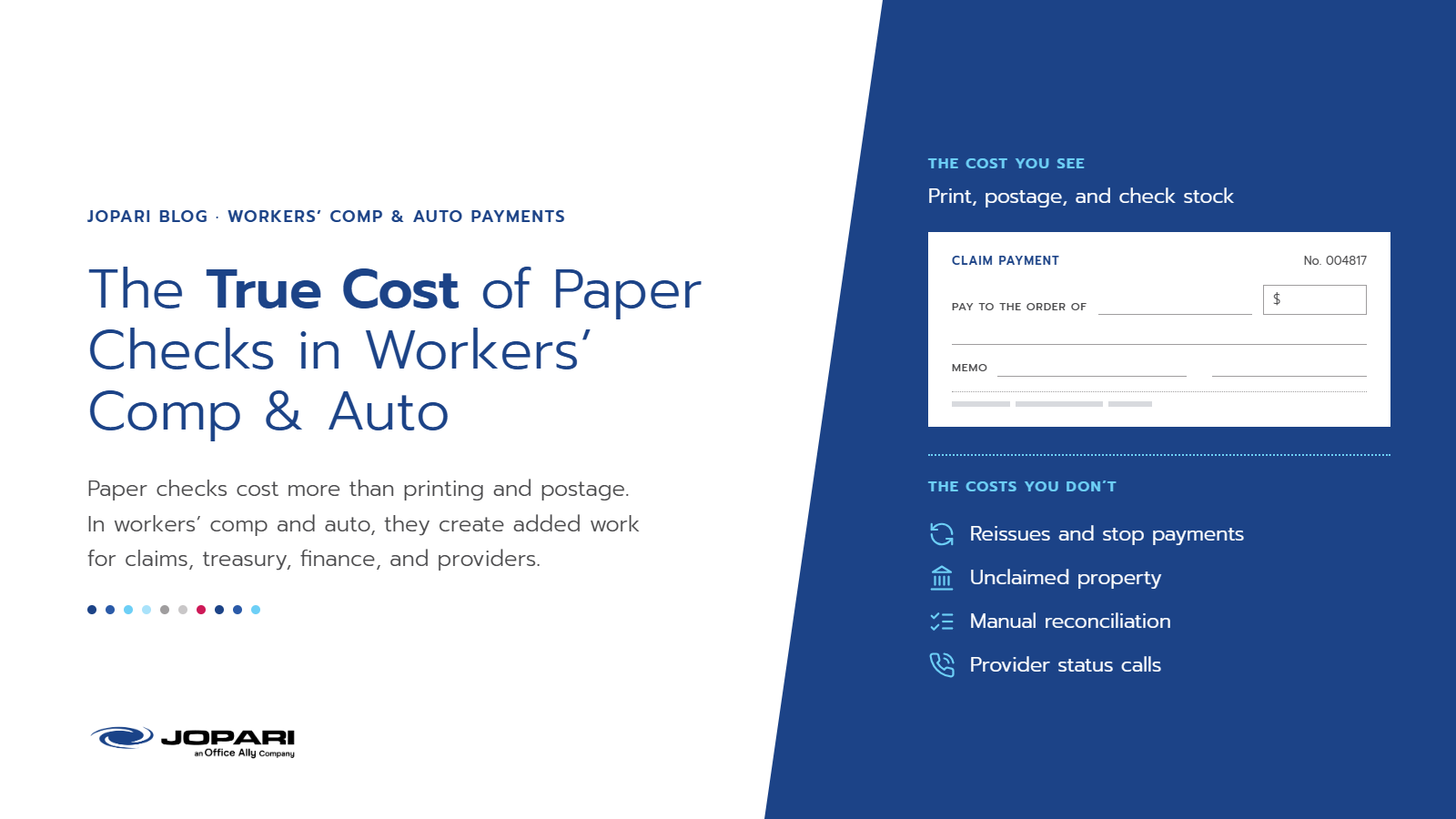
Ask most workers’ comp and auto claims organizations what a paper check costs, and the answer usually covers the basics: check stock, printing, and postage. Those costs are real, but they’re only part of the picture.
The larger cost of a paper check rarely sits on one line of the budget. It’s spread across claims, treasury, and finance through payment inquiries, reconciliation, and check reissues. It also creates additional work for the providers receiving those payments. That’s why it’s easy to underestimate and why electronic payment adoption in workers’ comp and auto often stalls even when everyone agrees paper is inefficient.
This post breaks down where those costs hide and offers a practical way to measure them.
The visible costs
The direct costs of issuing a check are the easiest to see:
- Check stock and secure printing
- Envelopes, inserts, and postage
- Mail handling and outbound processing
- Bank fees for check issuance and clearing
Because these are predictable and tied to a vendor invoice or bank statement, they’re usually what gets counted. On their own, they can make paper look manageable.
The hidden costs on the payer side
The bigger costs come after the check leaves the building:
Reissues and stop payments. Checks get lost in the mail, sent to an outdated address, or never cashed. Each one triggers a stop payment, a research effort, and a reissue, often with a call or two in between.
Unclaimed property. Uncashed checks don’t disappear. They become outstanding liabilities that must be tracked, followed up on, and eventually reported and remitted under state unclaimed property rules. That work typically lands on finance or treasury, well away from the claims team that issued the payment.
Reconciliation. A paper check and its Explanation of Benefits (EOB) travel by mail, while the electronic remittance advice (ERA or 835) may arrive several days sooner. That timing gap creates additional work for providers reconciling incoming checks with electronic remittance received days earlier. Payers must also track which checks have cleared, which remain outstanding, and which need follow-up.
Status calls. Providers waiting for a check may call to confirm whether payment has been issued and when it will arrive. Each call takes time from adjusters, bill review staff, or customer service, and many are about payments that are simply still in transit.
Fraud and control risk. Paper checks can be altered, stolen, or deposited fraudulently. Positive pay and other controls help, but they add their own cost and administrative work.
The provider side of the equation
The costs don’t stop at the payer. Providers who treat people injured at work or in auto accidents, from physical therapy practices to surgery centers, carry their own share:
- Waiting days for mail to arrive, then more days for funds to become available
- Opening, sorting, and depositing paper checks
- Reconciling paper checks with ERAs received days earlier and resolving missing or mismatched payments
- Calling payers about checks that have not arrived, even when the ERA shows payment was issued
For providers, these delays affect cash flow and staffing. Over time, they also affect how providers feel about working with a payer, which matters in workers’ comp and auto, where access to timely, quality care supports recovery and a return to daily activities, including work.
A practical way to measure the real cost
The most useful exercise is to measure cost per payment across departments, not just per check printed.
A simple framework:
- Direct issuance costs. Total spending on check stock, printing, postage, and bank fees for the period.
- Exception handling. The number of reissues, stop payments, and returned checks, multiplied by the staff time each takes.
- Reconciliation effort. Hours spent reconciling issued checks against bank activity, investigating discrepancies, and resolving outstanding payments.
- Inquiry volume. The number of payment status calls and the average handle time.
- Unclaimed property work. Time spent tracking uncashed checks, contacting payees, and preparing unclaimed property reports.
Convert staff time to dollars using fully loaded hourly labor costs, then add those amounts to direct expenses for the same period and divide by the number of checks issued.
Items two through five can add substantially to direct costs yet may go unmeasured because the work sits in different departments.
What changes with electronic payment
Electronic payment doesn’t just replace the check. When it’s done well, it removes most of the hidden steps:
- Funds arrive faster, without mail time or deposit delays
- Payment and electronic remittance are linked, making reconciliation simpler on both sides
- Payment status is visible, which reduces calls
- Lost and uncashed checks become far less common, which shrinks reissue and unclaimed property work
Reducing the cost, delays, and risks of paper payments is already prompting action beyond the insurance industry. In 2025, the federal government began phasing out paper checks, including an electronic payment transition for federal workers’ compensation benefits (U.S. Department of Labor, OWCP). While benefit payments differ from medical provider payments, the underlying concerns are relevant to workers’ comp and auto medical claims payers.
Moving forward
Moving to electronic payment takes planning, from technical implementation and systems integration to provider communication and adoption. Some providers will continue to prefer checks, and a payment program should account for that. Providers should also have clear information about any fees and access to a no-fee electronic payment option.
Understanding the full cost of paper is the starting point. Acting on that information can help payers reduce manual work, improve payment visibility, and get funds to providers faster. A phased transition allows organizations to build adoption over time while preserving provider choice.
Jopari ProPay® helps workers’ comp and auto medical claims payers make that transition with flexible provider payment options, payment status visibility, and payment information linked to the corresponding remittance. Connect with the Jopari team to explore how ProPay can reduce the work and cost associated with your paper payments.